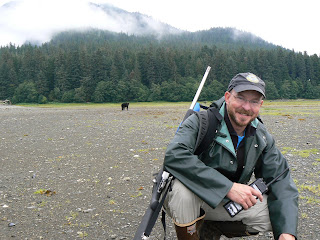
It's been awhile since I've posted with lots happening now that the days are longer and field work has begun. I spent the first part of May doing deer pellet surveys (counting piles of poop). Normally we would have started in April but there was too much snow again this year. So we had to wait until May and even after waiting there were lots of places we had to because of too much snow even at less than 700 feet elevation. But we went to some pretty cool places like Admiralty, Baranof, Chichagof and Prince of Wales Island to name a few. It was kind of cool and a bit spooky bushwhacking through some of the most densely populated brown bear country in North America.
Nature is always fascinating and even though it can be harsh. We saw quite a bit of evidence of this while out doing surveys. I came upon the bones of a black bear cub that had been eaten by wolves on P.O.W. island. We saw some cubs and subadult black and brown bears that seemed to be having a tough spring. But there were also alot of animals that seem to be doing well like the Sea Lions hauled out on the south end of Catherine Island and all the seals, porpoises and humpback whales that were out feeding in the frigid waters around the islands we worked on. We need those kinds of sights around here to put up with the short rainy days in the fall.
After returning from all the deer pellet work we had just a few days to get settled before we headed to Pack Creek again. I got there around June 22 last year and it was cool to see the bears feeding out in the meadows and occasionally see a subadult bear approach close but things didn't really pick up until the salmon run in July. This trip was quite different and definitely kept us on our toes. We rode out there in the 19 ft work skiff for almost five hours in 3-4 foot seas. While we weren't in any danger, it wasn't exactly enjoyable except for the fact that it was sunny and the mountains were spectacular. Well at least when I could see them once in awhile after my eyes finally stopped burning from all the salt water that would crash over the bow and soak my classes and rain gear. After we arrived at our camp on Windfall Island we had to set up the wall tent and then we were finally able to relax for a bit while one of our coworkers that flew out earlier made steaks on the fire.
The next day we used the skiff to cart a 250 gallon tank back and forth between Admiralty and Windfall Island were we keep our camp. This involved the use of three fire pumps which the forest service has on back packs for firefighting. Basically a pump with a lawnmower type pull start. We could only fill the tank with 150 gallons of water at time or the boat wouldn't be able to go fast enough to get anything accomplished. The guys that have worked there for years developed a really efficient system so that in less than five hours we had shuttled 7 or 8 tank fulls which was enough to fill the 1,000 gallon tank on our island with some left over for to flush the filters.
The next task was to go over to pack creek and take care of several downed trees that were lying across the trails. In some places they would just let them be but we can't do that because if people veer too far off the trail they could surprise one of the bears that frequent the area. After we finished cutting the trees and hauling wood off the trails we walked up to the viewing tower a mile into the woods. It's a very cool spot and the beavers were quite active over the winter so we noticed some new damns and as if we had planned it they thinned a few of the areas that were blocking some of the better bear viewing so that will help at least a bit this season.
Finally, on June 1st my coworker and I went over to the south spit to meet a plane with visitors and upon arriving noticed a subadult that we think we recognized from last year. The bear wasn't afraid of us and frequently when young they'll approach to "test" you. They get sick of being bullied by the other bears but also don't have mom around as back up so it's almost like they decide to see if they can find a situation where they can be the boss.
We always stand our ground and sometimes even have to give them some gentle encouragement to move away if they get too close. Since the young bear was coming we moved away from the treeline so we could pay attention to what it was doing and keep on eye on our human guests as well.
The bear headed down the beach past us and then suddenly ran off the down the beach after it heard something in the trees nearby. As we watched and listened we soon heard some brush moving and saw a young female bear pop out of the woods. Then we heard branches breaking like all hell was breaking loose inside the trees and a huge male came out huffing and puffing following her sent all the way down the beach until she jogged away. We waited about 20 minutes since that was the direction we were headed and then we walked around the corner to the viewing spit only to see the male out eating sedges. He was such and impressive animal with huge hump and probably as big as any bear I saw last year except that this spring and this bear will gain a ton more weight by the time it dens up for the winter after feasting on salmon, berries and plants.
After about a 1/2 hour the female popped out of the woods and the male started huffing again so she came right up to us probably for protection from him. Despite our shouting she came withing about 8 feet before stopping and then barely changed course as she walked along about 6 feet away from me. It's pretty amazing how much more I know than last year. This bear was closer than any I've ever seen an yet I wasn't nearly as nervous as the beginning of last summer when they would come within 30 feet. Anyway thankfully the male stayed out in the sedge until she was well clear of us and then decided to move on off after her. She seemed somewhat interested but I guess they wanted some privacy so we never got to see if she cooperated.lol
The next day we got to see a sow and cub from last year and the cub was over 100 lbs. It's pretty amazing watching these coastal brown bears knowing that the bears on the Alaska Peninsula are even bigger and not quite as big as the bears on Kodiak! I was recently sent photos of an 11 year old black bear sow from MN that weighed only 165lbs.
The final bit of drama was when the same young subadult from the day before was out eating sedge and then got chased by the female right toward the viewing spit! The young bear ran around us within 50 feet but the female just ran right across the edge of the spit within 25-30 feet at a full sprint. Well I guess that's all for now. I'm hoping that after the first two days the rest of the season won't seem boring. But I doubt that since we've gotten reports of lots of cubs this year and a group of film makers from PBS are shooting an episode called "Fortress of the Bears" due to air hopefully next winter. There's even a slight chance that some of us will be on the show although I'm guessing it won't be the new guy.
Check out this website for some of the photos I took. I'll add more here later if I have time.
http://www.flickr.com/photos/hikermedic/
Saturday, June 7, 2008

Sunday, April 27, 2008
More signs of spring in Juneau

It's pretty amazing here in spring we've had temps up near sixty last week but on the clear days it was down to low 30s at night with everyone(except me it seems) seeing the northern lights.lol
Everytime we get sunny weather I'm reminded of how amazing the mountains are. Since Juneau is at sea level a 2,000 ft mountain seems gigantic. The other day I hiked up the Spaulding Meadows trail and decided not to bring the snow shoes because everything down low was snow free and the trails are pretty packed. Once I get up there I discovered some of the nicest views in Alaska and the snow was so deep that tree wells(pockets created at the base of conifers) were five feet deep in some places. If I walked off the packed trail I'd break through up to my thighs and have to post hole my way around.

As I hiked around I could hear "hooters" (blue grouse) calling and lots of other birds were out and about.
Here are some photos from the North Douglas highway and outer point trail about twenty minutes from where I live.


The outer point trail is really nice because it gives good views of coastal Alaska. You can find sea anemonies, gulls, seals, harlequin ducks, barrows goldeneye, ravens, crows, eagles and of course mountains!
Spring in Juneau
Well it's been over a month since I've posted here. That's because the days have been getting much longer and it doesn't get dark until almost 9:00 at night. The big thaw was on and everything at sea level had melted completely with the roads finally dry and the everyone following the ordinance took their studded tires off the cars by April 15th only to be unprepared for the 12 inches of snow that dumped on us April 17th. Fortunately, the sun came out later that day and didn't go away for 8 days straight. I think that's the longest stretch that I've ever had in Alaska.
I'm about to start field work again very soon traveling to Sitka, Prince of Wales and then possibly somewhere else before I go to Pack Creek and the bears again at the end of May. I recently spent a week helping a biologist measure moose browse, collected pellet samples(aka moose poop) and then stayed behind for a few days working solo in order radio track in to find a few wild moose to see if they still had their calves.
After the week was over I'm pretty sure that I had about 15LBS of moose poop quadruple bagged in with my gear for the ride back to town on the Cessna. I got on the plane and barely had my seatbelt buckled when the other passenger complained to the pilot that the week before some new pilot(from a different air taxi) had forgotten to switch the fuel tanks and the engine quit so this guy puts on his life vest while the pilot is tapping the gauges and trying to figure out what happened.LOL! I was about to mention that it may be bad luck to discuss that kind of thing before you even get in the air when our pilot told a story of his own. Apparently when he was new the same thing happened to him with a plane load of tourists. He covered by saying "look at that moose down there" and then circled around the "moose" until the fuel line flowed again and they were none the wiser. I love to fly but it's occasionally very interesting as it was that day flying back in the snow with the pilot looking at the steering wheel of the plane 90% of the time because that's were the mapping instrument was and visibility was so low it was almost pointless to look out the windows until we got much closer to Juneau Airport.lol

I'm about to start field work again very soon traveling to Sitka, Prince of Wales and then possibly somewhere else before I go to Pack Creek and the bears again at the end of May. I recently spent a week helping a biologist measure moose browse, collected pellet samples(aka moose poop) and then stayed behind for a few days working solo in order radio track in to find a few wild moose to see if they still had their calves.
After the week was over I'm pretty sure that I had about 15LBS of moose poop quadruple bagged in with my gear for the ride back to town on the Cessna. I got on the plane and barely had my seatbelt buckled when the other passenger complained to the pilot that the week before some new pilot(from a different air taxi) had forgotten to switch the fuel tanks and the engine quit so this guy puts on his life vest while the pilot is tapping the gauges and trying to figure out what happened.LOL! I was about to mention that it may be bad luck to discuss that kind of thing before you even get in the air when our pilot told a story of his own. Apparently when he was new the same thing happened to him with a plane load of tourists. He covered by saying "look at that moose down there" and then circled around the "moose" until the fuel line flowed again and they were none the wiser. I love to fly but it's occasionally very interesting as it was that day flying back in the snow with the pilot looking at the steering wheel of the plane 90% of the time because that's were the mapping instrument was and visibility was so low it was almost pointless to look out the windows until we got much closer to Juneau Airport.lol

This is a cow moose with last springs calf(a bull). She was one of the less cooperative moose I tracked that week. She was initially close but it took over an hour to finally sneak up enough to see the calf bedded down nearby. They were nice enough to stand up for a photo and then decided to continue browsing a bit further away.
Thursday, March 20, 2008
Moose research photos
Here's some photos of the moose research I was privelidged to take part in. In the first two I'm attaching an ear tag.


The snow was so deep that the moose seem to be using the creek beds to escape the wolves in the area. I quickly learned after sinking into deep snow that the moose were taking the smart approach. The weather was so perfect I couldn't help but smile.

Here I am preparing to "collect" a pellet sample.


The snow was so deep that the moose seem to be using the creek beds to escape the wolves in the area. I quickly learned after sinking into deep snow that the moose were taking the smart approach. The weather was so perfect I couldn't help but smile.

Here I am preparing to "collect" a pellet sample.
Sunday, March 16, 2008
Moose, Wolves, helicopters and other stuff
When I moved to Alaska my friends a the moose pens told me that the short dark days in winter keep you sluggish and then the long days of spring and summer bring out an almost manic feeling. Sometimes that's the perfect description life in Alaska. Back in December sunrise was about 8:30-9:00am and a we could look out our office windows and see it get dark by about 3:15pm. Once we had a good snowfall things brightened up a bit but until then some days were a bit tough for most of us outdoor lovers. Now with the recent changing of the clocks sunsrise today is 7:09am and sunset is 7:04pm which seems very late even though summer will have sunsets at 11pm or later!
The longer days are good because they allow more time for field work. I recently got to help some of the best people in the busisness work on a moose study. After working at the Moose Pens on the Kenai I had learned an awful lot from the top moose people in the state which came in handy since it was my first time working out of a helicopter to capture moose. I have seen it from above several times but actually landing next to rivers and flying just over tree tops and seeing the places that the pilots can land was incredible! These studies are very important to the survival and management of moose populations so it was amazing to be able to help.
I've been around helicopters dozens of times during medical evacuations of critically ill patients down south but this was quite different. The main difference is that most of the medical evacuations where I came from included a fire department setting up a landing zone that was very safe and often the helicopter rotor was shut down until after the patient got loaded and everyone was safely clear of the rotors.
Field work in the wilderness using a helicopter is a totally different and amazing experience. First of all at the beginning of the day the helicopter lands and the door is remove on the passenger side and the rest of the day you fly without the door on that side! This is to facilitate safely and accurately darting the animal with tranquilizing drugs. To make the helicopter as maneuverable as possible they drop two of us off while the biologist goes with the pilot and darts the moose. Then depending on the situation he stays with the moose and we get picked up and dropped off as close as possible to the tranquilized moose. This means that for almost the entire day you climb out and stand on the skids of the helicopter with the rotor still going and grab your gear then while ducking low enough to avoid decapitation you try to walk on the snow hoping not to break through into the deeper stuff which slows you down alot. Often the helicopter is using some rotor power to keep from sinking into the snow and tipping over.
Once you move out of rotor range you get down on one knee with you're back to the chopper and get blasted by a huge rush of air and snow blowing at you and into any part of your clothes that aren't sealed tight. The wind is so strong that on one occasion I made the mistake of kneeling on both legs and when it took off it would have knocked me over if my coworker hadn't grabbed me. Once out of rotor range we had to get to the moose as fast as one can while occasionally breaking through up to our waist in the snow(in one case I was chest deep for several minutes). We were in chest waders and often got to the moose in or near streams. I soon learned from the experienced guys that if you could make it into the stream you could move much faster by walking in the stream as long as you could get back up the snow bank when you got close enough to the moose.
Imagine trudging across deep snow and through icy cold streams(I'm so glad they told me I needed insulated waders) and then reaching a moose that ways 800-1100lbs and lays down wherever it wants to. The biologist I got to work with is amazing and often had blood drawn before we even got to the moose. However, on some occasions the moose had layed down in streams and one of us had to hold it's head above water until after the work was done and the reversal drug had kicked in. This meant waiting until the last possible moment and then getting as far away as possible to avoid stressing the moose any further.
Where there's moose there are usually also wolves. While we were working on moose the spotter plane saw several moose kills and one was so fresh that the wolves were still feeding on it. Everywhere we went there were tons of tracks nearby and we even had to land on an old carcass to collect bone, teeth and what was left of an old radio collar. We can encourage hunters not take moose with collars(although they sometimes still do) but the wolves really don't care which moose they hunt as long as it's slow enough to kill. It always amazes me to see how clean the bones look after the wolves, ravens, magpies, etc. are done with it. As you can imagine it was a very interesting day. It was much needed after months of dull data entry. The field season is finally coming up again soon so I'll be away from the computer for up to to weeks at time but hope to update when possible. Thanks all the great comments on the blog. I'll try to update with photos as soon as I can get them from the gang.
The longer days are good because they allow more time for field work. I recently got to help some of the best people in the busisness work on a moose study. After working at the Moose Pens on the Kenai I had learned an awful lot from the top moose people in the state which came in handy since it was my first time working out of a helicopter to capture moose. I have seen it from above several times but actually landing next to rivers and flying just over tree tops and seeing the places that the pilots can land was incredible! These studies are very important to the survival and management of moose populations so it was amazing to be able to help.
I've been around helicopters dozens of times during medical evacuations of critically ill patients down south but this was quite different. The main difference is that most of the medical evacuations where I came from included a fire department setting up a landing zone that was very safe and often the helicopter rotor was shut down until after the patient got loaded and everyone was safely clear of the rotors.
Field work in the wilderness using a helicopter is a totally different and amazing experience. First of all at the beginning of the day the helicopter lands and the door is remove on the passenger side and the rest of the day you fly without the door on that side! This is to facilitate safely and accurately darting the animal with tranquilizing drugs. To make the helicopter as maneuverable as possible they drop two of us off while the biologist goes with the pilot and darts the moose. Then depending on the situation he stays with the moose and we get picked up and dropped off as close as possible to the tranquilized moose. This means that for almost the entire day you climb out and stand on the skids of the helicopter with the rotor still going and grab your gear then while ducking low enough to avoid decapitation you try to walk on the snow hoping not to break through into the deeper stuff which slows you down alot. Often the helicopter is using some rotor power to keep from sinking into the snow and tipping over.
Once you move out of rotor range you get down on one knee with you're back to the chopper and get blasted by a huge rush of air and snow blowing at you and into any part of your clothes that aren't sealed tight. The wind is so strong that on one occasion I made the mistake of kneeling on both legs and when it took off it would have knocked me over if my coworker hadn't grabbed me. Once out of rotor range we had to get to the moose as fast as one can while occasionally breaking through up to our waist in the snow(in one case I was chest deep for several minutes). We were in chest waders and often got to the moose in or near streams. I soon learned from the experienced guys that if you could make it into the stream you could move much faster by walking in the stream as long as you could get back up the snow bank when you got close enough to the moose.
Imagine trudging across deep snow and through icy cold streams(I'm so glad they told me I needed insulated waders) and then reaching a moose that ways 800-1100lbs and lays down wherever it wants to. The biologist I got to work with is amazing and often had blood drawn before we even got to the moose. However, on some occasions the moose had layed down in streams and one of us had to hold it's head above water until after the work was done and the reversal drug had kicked in. This meant waiting until the last possible moment and then getting as far away as possible to avoid stressing the moose any further.
Where there's moose there are usually also wolves. While we were working on moose the spotter plane saw several moose kills and one was so fresh that the wolves were still feeding on it. Everywhere we went there were tons of tracks nearby and we even had to land on an old carcass to collect bone, teeth and what was left of an old radio collar. We can encourage hunters not take moose with collars(although they sometimes still do) but the wolves really don't care which moose they hunt as long as it's slow enough to kill. It always amazes me to see how clean the bones look after the wolves, ravens, magpies, etc. are done with it. As you can imagine it was a very interesting day. It was much needed after months of dull data entry. The field season is finally coming up again soon so I'll be away from the computer for up to to weeks at time but hope to update when possible. Thanks all the great comments on the blog. I'll try to update with photos as soon as I can get them from the gang.
Sunday, March 9, 2008
Is spring on the way to Juneau?
I decided to get some exercise yesterday and so I went for a hike on the treadwell ditch trail up the street from my house. Hiking this time of year is different because we've had some warm temperatures with rain and then colder temps with a snow rain mix and so there's kind of a freeze thaw thing happening. It seems like "break up" is definitely in full swing though with the channel completely clear of ice. Since the trail I was planning on hiking goes up the shady side of the mountain and seemed pretty firm I figured maybe I could do it without snow shoes. That is until I got out in the open and broke through the crust sinking up to my waist in slushy snow.
After extricating myself I decided to change the plan since I was solo hiking and didn't bring my snow shoes. I drove down the road a place called "otter point" that I hiked in 2003 with my parents. It's a very cool walk through the rainforest down to the rocky coast of the Gastineau Channel. When I got to the shoreline there were hundreds of Surf Scoaters along with Barrows Goldeneye, Harlequin Ducks, Mergansers and even a few harbor seals swimming around. Most of the birds were too far for good photos but it seems like the migration is in full swing. It's been warm enough that there's even been reports of bear activity in parts of southeast.
The best part of spring though is more daylight. Even before we turned the clocks forward we've had longer days. Today it was light out at about 6:45AM until almost 7PM which is having and effect on us all. When I first moved here a friend told me that winter everyone drags around in slow motion and then when spring hits the "manic" phase begins. I'm already starting to feel it alittle although not as much as when I lived on the Kenai where the sun is out longer an even the Moose get stir crazy! I just figured I'd give everyone an update since it's been awhile. No photos this time.lol
After extricating myself I decided to change the plan since I was solo hiking and didn't bring my snow shoes. I drove down the road a place called "otter point" that I hiked in 2003 with my parents. It's a very cool walk through the rainforest down to the rocky coast of the Gastineau Channel. When I got to the shoreline there were hundreds of Surf Scoaters along with Barrows Goldeneye, Harlequin Ducks, Mergansers and even a few harbor seals swimming around. Most of the birds were too far for good photos but it seems like the migration is in full swing. It's been warm enough that there's even been reports of bear activity in parts of southeast.
The best part of spring though is more daylight. Even before we turned the clocks forward we've had longer days. Today it was light out at about 6:45AM until almost 7PM which is having and effect on us all. When I first moved here a friend told me that winter everyone drags around in slow motion and then when spring hits the "manic" phase begins. I'm already starting to feel it alittle although not as much as when I lived on the Kenai where the sun is out longer an even the Moose get stir crazy! I just figured I'd give everyone an update since it's been awhile. No photos this time.lol
Sunday, March 2, 2008
The Juneau Wolf
 A friend of mine mine gave me this photo of "Romeo." I've been hearing about Juneau's local resident wolf ever since I moved here. The black wolf, whom locals have come to call "Romeo," has created quite the controversy here in town. This wild wolf is frequently seen by locals and heard howling around the Mendenhall glacier, lake, visitor center and campground area during the winter months. I must admitt that the chilling sound has a profound effect on me until I'm reminded that he has become very habituated to humans.
Forest Service employees and Fish and Game staff repeatedly remind folks to keep their distance and shout at the wolf to scare him off when he approaches. Unfortunately these warnings seem to fall on deaf ears. Lots of people instead trying to chase the wolf off go looking for him while hiking or skiing with their dogs off leash with the hope that he'll "play" with their dogs. This creates quite the commotion when the wolf shows up. Last winter a pug ran up to him and the wolf suddenly reminded everyone that it is in fact a wild animal. The Juneau Empire got photos of the wolf as it picked up the pug and flung the terrified dog several feet. The stunned pug then layed there for a while playing oppossum. Thankfully the dog was left in one piece. But what will happen next time?
Subscribe to:
Posts (Atom)